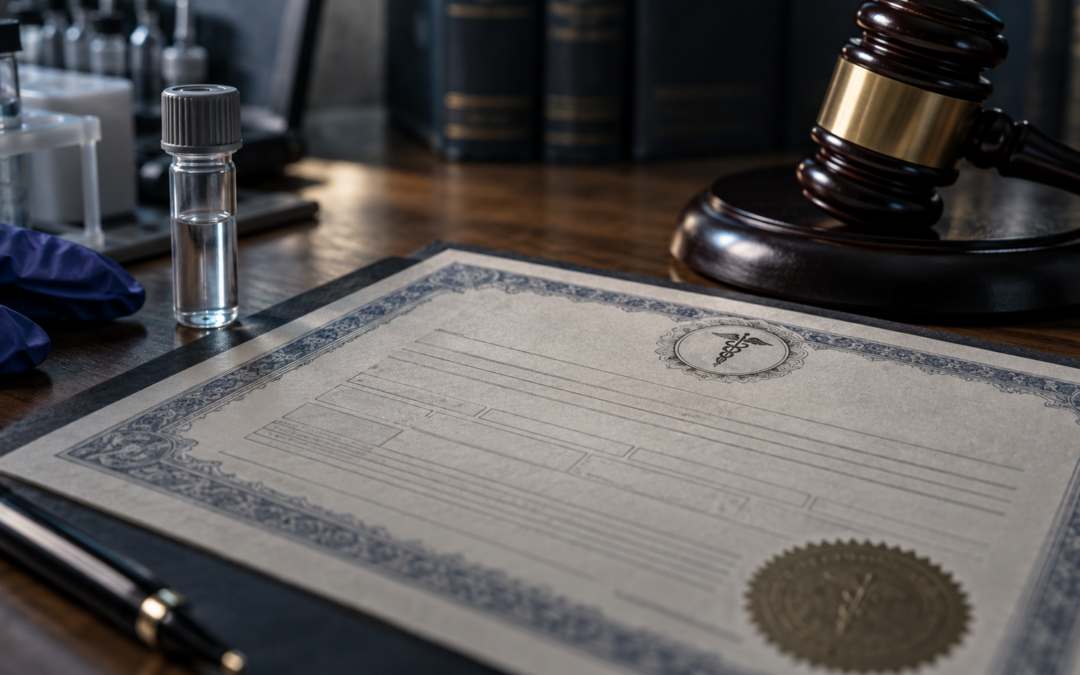
A fentanyl death certificate rarely tells the full story. It lists a cause and a manner of death, but not how investigators got there, and it does not carry a case into court. That job belongs to postmortem toxicology, the testing that identifies which drugs were present, and at what levels, giving families and their attorneys the first step toward holding a dealer accountable.
In 2026, prosecutors across the United States brought a fresh wave of drug-induced homicide fentanyl prosecution cases against dealers, even as coroner backlogs and a pathologist shortage drag out the wait for answers.
How Postmortem Toxicology Confirms a Fentanyl Overdose
Postmortem toxicology detects and measures drugs in blood, tissue, and other fluids collected during an autopsy. This answers how does postmortem toxicology confirm a fentanyl overdose: samples go through screening, then a follow-up test, usually mass spectrometry, that confirms the result and rules out false positives.
Fentanyl is potent in tiny amounts, so results need to be precise. A lab also checks concentration levels, other drugs of abuse present, and the decedent’s medical history against the manner of death on the autopsy report.
The coroner and medical examiner’s office usually orders this testing, and the results shape the autopsy report, then the fentanyl death certificate itself.
What Does a Coroner Toxicology Screen Test For, and Why the Wait
Families often ask why do toxicology reports take so long. A coroner toxicology screen checks a set panel of drugs: common opioids, stimulants, sedative drugs, and other controlled substances. This covers volume, not depth, so it misses illicit drug variants outside the panel.
How long does it take to get an autopsy toxicology report? That depends on where the death occurred. A few factors slow it down:
- A national pathologist shortage and medical examiner delays
- Coroner backlog toxicology results in high-caseload counties
- Complex cases needing extra rounds of testing
A report can take anywhere from a few weeks to several months, a delay that matters a great deal to a family member waiting on answers, or an attorney racing a filing deadline.
The Difference Between a Coroner Toxicology Screen and a Forensic Toxicology Review
A standard coroner screen exists to set the manner of death for public record. It cannot survive cross-examination in a fentanyl wrongful death lawsuit or a criminal trial. The difference between a coroner toxicology screen and a forensic toxicology review comes down to depth: one is a public-record screen, the other a courtroom-ready review, and that is where an independent forensic toxicology review comes in.
Families or attorneys often request one through an outside death investigation service. A forensic pathologist outside the original county process reexamines the samples or case file, with peer review built in, checking the findings against scene evidence and law enforcement agencies’ reports.
For a fentanyl overdose death criminal case or a civil claim, this gap matters. A fentanyl toxicology report often needs a pathologist willing to testify to hold up in front of a jury.
How Toxicology Findings Support Criminal and Civil Cases
Toxicology results drive two legal paths, and both rely on the same data.
On the criminal side, prosecutors ask can a fentanyl dealer be charged with someone’s death. In many states, yes, through drug-induced homicide or similar laws, but the case needs toxicology tying the fentanyl in the decedent’s system to a specific supplier.
On the civil side, families ask can families sue for a fentanyl overdose death, especially when a facility or property owner had a duty of care and failed to act. How to prove fentanyl caused a death in a civil claim comes down to the same lab findings: concentration, timing, and a clear medical opinion linking the drug to the death.
Families benefit from support built for people navigating a death investigation, since requesting records is unfamiliar territory for most.
Chain of Custody: Keeping Toxicology Evidence Admissible
None of this testing matters in court if the evidence cannot be trusted. Chain of custody for toxicology evidence is the paper trail behind every sample: who collected it, how staff stored it, and who handled it along the way.
A single break in that chain gives defense attorneys an opening to challenge the fentanyl toxicology report. Strong practices include:
- Sealed, labeled sample containers with tamper indicators
- A signed transfer log for every handoff
- Secure, temperature-controlled storage during testing
- Documentation matching the county death investigation office’s own case file
Attorneys should request this documentation early, before records get harder to find. When the county file leaves gaps, an outside forensic pathology team can help close them before trial.
Moving From a Death Certificate to a Resolved Case
A fentanyl death certificate marks the start of a legal process, not the end of one. The postmortem toxicology behind it carries a criminal prosecution or a wrongful death lawsuit forward, whether from a standard coroner screen or a more rigorous independent forensic toxicology review. Families and attorneys who grasp that, and move fast to secure records, stand in a much stronger position.
If a loved one’s case involves unanswered toxicology questions, reaching out for guidance made for grieving families is a solid next step, alongside talking to an experienced attorney.
The Centers for Disease Control and Prevention reports that illegally made fentanyl now causes roughly seven out of ten drug overdose deaths in the United States. That scale of opioid overdoses has strained testing capacity nationwide, a gap the National Institute of Justice documented in its review of forensic labs.
Frequently Asked Questions
Q: How does postmortem toxicology confirm a fentanyl overdose? A: Labs screen blood and tissue samples, then confirm results with mass spectrometry, weighed against scene evidence and medical history.
Q: What does a coroner toxicology screen test for? A: A set panel of common drugs, including opioids, stimulants, and sedative drugs, built to set cause and manner of death quickly, not to catch every substance.
Q: Why do toxicology reports take so long? A: A pathologist shortage, medical examiner delays, and coroner backlog toxicology results are the main causes, stretching reports to weeks or months.
Q: Can a fentanyl dealer be charged with someone’s death? A: In many states, yes, through drug-induced homicide or similar laws, but the case relies on toxicology linking the fentanyl to the supplier.
Q: Can families sue for a fentanyl overdose death? A: Often yes, against a dealer, facility, or negligent party. Proving the claim needs the same toxicology data as a criminal case, plus a causal opinion from a forensic pathologist.